Seven windows on one unfolding
The same quiet order arrives everywhere at once: safer, kinder, more convenient than what it replaces, and almost impossible to refuse. The Endurance tells that arrival seven times over, from seven corners of the world, through seven people who never expected to be the ones who had to decide.
United States, England, Nigeria, Germany, China, South Korea and Australia. Each series is a trilogy with a prequel novella, and each stands completely on its own. Read together, they show how ordinary people meet something that is almost, but not quite, the truth.
One clock
The seven series run on a single timeline. When something happens in one window, it happens in all seven at the same moment. Thursday afternoon in America is Friday before dawn in Melbourne. A reader who crosses from one series to another arrives at the same hour, seen from somewhere else.
The end of the world, lived
Most stories about the end of the world are about spectacle. The Endurance tells it as lived experience: the night shift, the school run, the church roster, the rent, and a peace everyone prayed for, arriving with a face people trust. The catastrophe doesn't kick the door in. It is invited, by good and ordinary people, one reasonable step at a time, because every step looked like kindness.
No one in these books is taken out before it gets hard. Seven ordinary people go through it rather than around it, and each of them faces the same question: can you still see clearly when seeing clearly costs you everything?
Seven letters, seven series
Revelation opens, before any of its famous catastrophes, with seven short letters to seven churches. The Endurance reads them as a mirror held up to the church today: seven conditions, all present in the world at once. The comfortable and the hunted, the powerful and the small, the ones who are right about everything and the ones who welcome everyone.
Each series is built on one of those letters. Each meets the same crisis with a different blind spot, and each is deceived, or kept, in a different way. Readers who know the letters will hear them in the titles.
Three books, three movements
Every trilogy moves through the same three movements on the same clock. Book One moves through the seals, from a peace that holds to the day it breaks. Book Two moves through the trumpets and the mark. Book Three moves through the bowls, to the Return.
A prequel from living memory
Each series has a prequel novella set in real history, within living memory: occupied Thessaloniki, Pyongyang in 1938, a radio pulpit in Depression-era Detroit, the Blitz, Biafra, the Cultural Revolution, the Stasi's Berlin. Each follows someone in the lead's family who lived through something that rhymes with what is coming, and what they learned is handed down. The faces and the technology change. The choice does not.
Where they meet
The seven never meet on earth. They meet after the Return. Each of the seven letters ends with a promise to the one who overcomes, and The Eighth Day, the two-book close, is where those promises are kept. Seven roads, one homecoming.
How to read it
The Bread of the Stranger: a complete novella, and the easiest way in.
Any of the seven series, in any order. Each is a trilogy plus a prequel.
The Eighth Day: the two-book close, where all seven meet.
What’s next
The first window, Fairer, Safer, is publishing now: The Wrong Light is out, and the rest of the series follows. The other six follow. More windows are being written.
A note from the author
This is a story, not a chart. The Endurance isn't a dogmatic timeline of the end times, and it shouldn't be read as one.
The books draw on prophecy from across Scripture: Daniel, the Gospels, Paul's letters, Revelation and others. Some of it I've rendered literally, some symbolically, and some I've left out, because the books stay with what the characters actually live through. I hold the spine with conviction and the details with an open hand.
There are no larger-than-life heroes here, and no present-day public figure is written into any character. These are ordinary people, the kind you might sit beside at work or in church, and they're meant to be recognisable.
The series is written from a post-tribulation reading: the faithful are kept through, not taken out. It's a reading, not a test of fellowship, and readers who see it differently are written with respect throughout. If the books start a conversation, they've done what I hoped.
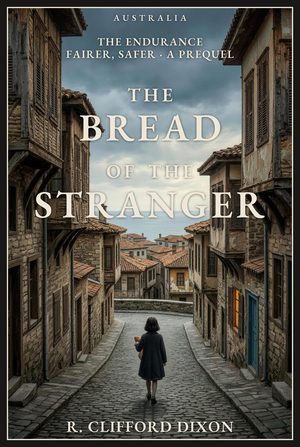
Start with The Bread of the Stranger
A complete novella, free when you join R. Clifford Dixon’s readers’ list. “These will be papers to say whether you eat.”
One list, one writer. Unsubscribe any time.